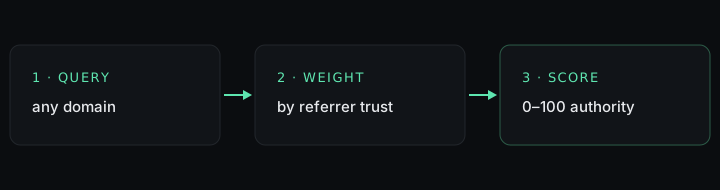
"Domain authority" started as Moz's trademarked metric, but the underlying idea — a single number that approximates how much a search engine or a careful reader should trust a domain based on who links to it — is now something most SEO tools compute their own version of. BacklinkMCP's version is an editorial-authority score: a domain_rating-style 0-100-ish number, weighted so links from Wikipedia, .edu, .gov, and established news domains count for meaningfully more than an arbitrary low-authority site linking in bulk. It's computed from BacklinkMCP's proprietary web-scale link index.
Try it
The endpoint
A single GET request returns the score:
curl "https://backlinkmcp.com/api/v1/authority?domain=stripe.com"
Response shape:
{
  "ok": true,
  "authority": {
    "domain": "stripe.com",
    "found": true,
    "domain_rating": 80.9,
    "referring_domains": 702082,
    "links_out": 41
  }
}
What each field means
domain_rating— the editorial-authority score itself, roughly 0-100, higher is more authoritative.referring_domains— the count of distinct domains linking in, from our link index.links_out— outbound link count for the queried domain, useful as a rough signal of how much of a hub vs. destination a domain is.found—falseif the domain has no inlinks on record (very new or very obscure domains). A falsefoundis not an error — it's a valid, if uninteresting, answer.
Why editorial weighting instead of raw link count
A domain-authority number that just counts inbound links is trivially gameable — link farms and comment-spam networks, the exact pattern Google's spam policies target, can inflate a raw count cheaply. Weighting toward wiki/edu/gov/news referrers makes that much harder to fake, because those are exactly the domains that are hardest to get a spam link placed on. It's not a perfect defense, but it's a meaningfully better signal than a naive count, and it's why two domains with the same total inlink count can score very differently here.
Calling it from code
Because it's plain JSON over HTTP, it works from any language without an SDK:
const r = await fetch(
  "https://backlinkmcp.com/api/v1/authority?domain=" + encodeURIComponent(domain)
);
const { ok, authority } = await r.json();
if (ok && authority.found) {
  console.log(authority.domain_rating, authority.referring_domains);
}
And because it's also exposed as an MCP tool (domain_authority_score), any MCP-aware coding agent can call it directly mid-session without you writing any integration code at all — see the MCP install docs.
Rate limits and pricing
10 lookups/day per IP on the free tier, no signup. Unlimited on the $19/mo Pro plan. Full details, including the exact error shape returned when you hit the limit, are on the docs page.
What this number is not
To check whether a linking domain's homepage still has an href to you today, use verify_link_live — it fetches the linker homepage, not inner pages. If you need continuous day-to-day link-velocity monitoring, see the honest comparison on the Ahrefs alternative page for where a continuous crawler like Ahrefs is still the better tool. For the full metrics bundle (this score plus referring domains and outbound links) in one response, see the domain metrics API; for the ranked list of who's actually linking in, see bulk backlink analysis.
How this compares to Moz DA and Ahrefs DR
If you already track domain authority in another tool, the most important thing to know is that the numbers are not interchangeable. Moz's Domain Authority, Ahrefs' Domain Rating, and BacklinkMCP's editorial-authority score are three independent models built on three different link graphs, each normalised on its own curve. A domain that scores 62 in one can easily score 55 or 71 in another — that's expected, not a discrepancy to reconcile. What travels reliably between tools is the ordering: a domain that clearly outranks another on inbound-link trust tends to do so in all three. Use our score to compare domains within this index — you against a competitor, one outreach prospect against another — rather than to reproduce a specific figure you saw elsewhere. And because it is computed from our own link index, it moves when that index updates, not on a live per-request crawl.
Frequently asked questions
Is this the same as Moz Domain Authority?
No. "Domain Authority" is Moz's trademarked metric. This is an independently computed editorial-authority score that approximates the same underlying idea — how much trust a domain has earned from who links to it — but the two numbers come from different models and should not be compared point-for-point.
How often does the score update?
It reflects the current state of our link index rather than a live crawl performed at request time. verify_link_live fetches a linking domain's homepage (not a specific inner page) to confirm a live href today.
What counts as a good domain authority score?
Higher is better on a roughly 0-100 scale, but the absolute number matters less than context. A score of 40 can be excellent in a niche where the leaders sit at 45, and unremarkable in one where they sit at 80. Compare a domain to its direct competitors, not to a fixed threshold.
Do I need an API key?
Not for the free tier — 10 lookups per day per IP, no signup. A Pro key lifts the daily limit and returns fuller ranked linker lists.
Can an AI agent call this without any integration code?
Yes. The same scoring is exposed as the domain_authority_score MCP tool, so any MCP-aware agent — Claude Desktop, Claude Code, Cursor — can call it mid-conversation. See the install docs.