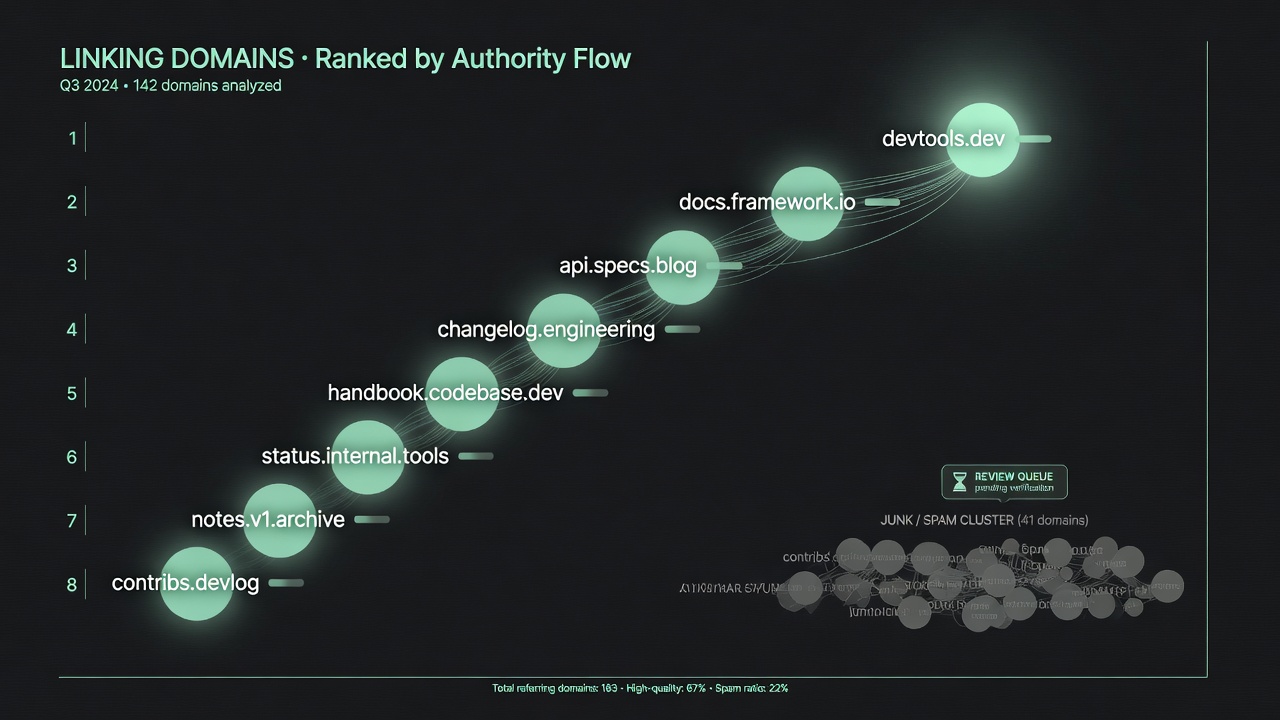
A “toxic backlink” is SEO slang for an inbound link you put on a review list — not a Google ranking-factor name, and not an automatic disavow instruction. Vendors sell percentage scores; we return a heuristic queue on the low-authority linker tail of a domain-level index.
That matters, because a lot of expensive tools sell fear: a red score, a long disavow file, a monthly monitoring fee. You can do a useful first pass without that stack — if you stay honest about what a heuristic can and cannot prove.
What people usually mean by “toxic”
In practice, reviewers flag domains that show patterns associated with link schemes or low-trust neighborhoods:
- Suspicious TLDs or random multi-character brand names with no real site
- Domains that link out to thousands of unrelated targets (directory / link-farm behavior)
- Obvious adult, pharma, casino, or malware-adjacent niches when your site is unrelated
- Patterns that match known PBN or spam-network footprints
None of those alone is a guilty verdict. A .xyz domain can be a legitimate startup. A high outbound count can be a news site’s link-heavy template. Toxicity language is a prioritization tool: “look here first,” not “delete this from Google.”
How Google actually treats bad links
Google’s public position for years has been that its systems are good at ignoring most spammy links, and that the disavow tool is for rare cases — typically a manual action for unnatural links, or a documented negative-SEO attack. Search spam policies cover paid links and scaled exchanges; disavow help repeatedly tells most sites not to upload huge speculative lists “just in case.”
As of 2026-08-19 we coded r/SEO threads on this fight: one camp says junk links have been ignored since ~2016; the other still mass-disavows anything under an arbitrary DA cutoff. We do not link those threads. If you only remember one line: most sites should not casually disavow.
Context from our index (authority path, 2026-08-19)
The listing/toxic path was down this day, so we did not invent a toxicity %. These are editorial-authority scores from the same graph — the backdrop a reviewer should have before staring at a low-authority tail:
| Domain | domain_rating | referring_domains |
|---|---|---|
| wikipedia.org | 87.6 | 2,155,083 |
| github.com | 81.3 | 750,824 |
| stripe.com | 80.9 | 702,082 |
| ahrefs.com | 69.7 | 109,300 |
| vercel.com | 58.6 | 17,272 |
As of 2026-08-19 — snapshot from domain_authority_score. Listing/backlinks 502, so no tail-flag table today. domain_rating is 0–100; linker authority on backlink rows is a raw integer, not the same scale.
What BacklinkMCP’s flag_toxic_links actually does
BacklinkMCP exposes a tool called flag_toxic_links over the remote MCP server (see the docs tools section). It is deliberately not marketed as “Google will punish you for these links.” It is a heuristic review list built from domain-level signals available in our index — things like TLD patterns, name patterns, authority, and outbound-link counts on the linkers we return.
Critical scope limit: flag_toxic_links scores the low-authority tail (order=asc, deeper recall) — the opposite of the default top-authority linker list. It is still a domain-level heuristic on a bounded slice (not every junk domain that ever linked you, and not proof a domain is toxic). If a tool claims to audit your entire dark long-tail of spam, it is doing a different job than we do.
- Output = candidates to review
- Not an auto-disavow file
- Not a confirmation that Google will count the link as spam
- Not a full-web spam crawl
That honesty is the product. Agents can call flag_toxic_links, group results, and draft a human review checklist. A human still decides whether anything rises to a disavow case under Google’s guidance.
A practical workflow without a $100+/mo suite
- Map who links you at all. Use
backlinks_for_domainor the REST domain authority / backlinks APIs to see ranked referring domains and authority context. Companion reading: anatomy of a backlink and what domain authority measures. - Run heuristic flags. Call
flag_toxic_linksvia MCP on your domain. Treat hits as “open in a browser and judge,” not “paste into disavow.txt.” - Verify anything that matters live. Index data is not a continuous live crawler. Use
verify_link_livewhen you need to know if a homepage link still exists today. - Disavow only with cause. Manual action, documented attack, or a clear unnatural pattern you understand — not a weekly toxicity dashboard ritual.
See your linker profile first (live demo)
flag_toxic_links is an MCP analysis tool, not a public REST toxic endpoint on this page. What you can run in the browser is the same authority + ranked-linker view that feeds human review — the first step before any toxic heuristic:
High links_out combined with odd branding is a common manual red flag; low links_out from a real publication is usually fine. Pair that table with the MCP toxic tool when you are ready to automate the first pass inside Claude or Cursor.
What this article is not telling you to do
Do not mass-disavow every low-authority linker. Do not treat a vendor “toxicity %” as a ranking factor. Do not assume BacklinkMCP’s heuristics see every spam linker on the web — they operate on the low-authority tail slice returned by our proprietary web-scale link index. For install and tool schemas, use /docs. Free tier is 10 lookups/day and 25 backlink rows; Pro is operator-issued (self-serve checkout is not live).
Further reading
- Docs — MCP tools including
flag_toxic_links - Domain authority API — REST shapes
- What is domain authority?
- Anatomy of a backlink
- MCP server for SEO — free remote MCP overview
FAQ
Does a toxic score mean Google will penalize me?
No. Ours is a heuristic review queue on the low-authority tail. It is not a ranking factor and not an auto-disavow list.
Should I disavow every low-authority linker?
No. Most sites should not casually disavow. Use the queue to look, then leave ordinary junk for the search engine to ignore.
Can this tool see the linking URL or rel=nofollow?
No. The index is domain-level: referring domain, authority, outbound count. No per-link URL, anchor, or rel.